
The Empire That Couldn’t Execute: All-Time Strategy Trap Fail #1
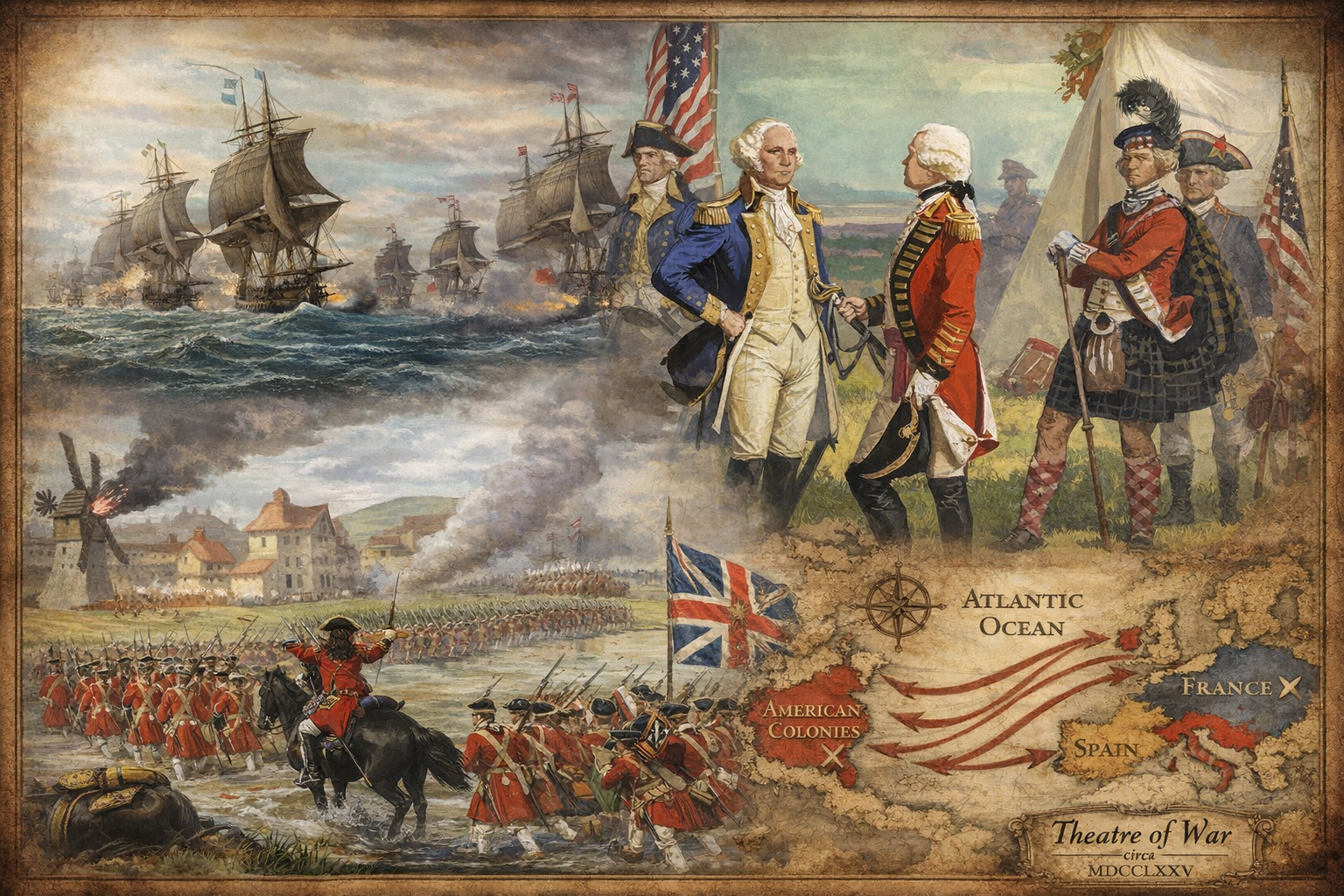
In 1775, British Empire was the mightiest force on earth.
Its navy ruled the seas. Its army was professional, disciplined, and well-equipped. Across the Atlantic stood a loose collection of farmers and merchants. No standing army. Little money. Fewer weapons.
From London’s perspective, the outcome seemed inevitable.
Yet six years later, Britain surrendered at Yorktown.
How did the most powerful empire in history lose to an under-resourced rebellion?
The British objective was straightforward: suppress the uprising and restore royal authority.
They believed superior force would produce a swift, decisive victory.
On paper, the strategy was coherent.
The problem was the assumption that power alone would carry them to victory.
The Trap: Ambition Without Capacity
Britain lost because its ambition outpaced its ability to execute.
Decisions were made in London—weeks away by ship. By the time orders reached commanders in America, conditions on the ground had already changed.
Generals acted independently, pursuing separate campaigns instead of a shared plan. Coordination fractured, costs mounted, and the advantage eroded.
At the same time, Britain was fighting global conflicts with France and Spain.
Its resources were stretched thin. Its supply lines were fragile. And its political will eroded.
They kept doing more—everywhere—without the capacity to sustain it.
How the Six Cs Would Have Helped
In The Strategy Trap, I describe the Six Cs system—the execution conditions required to turn a strategy’s ambition into results.
Two Cs could have particularly helped here.
Capacity
Capacity is about matching the strategy’s ambition to what can actually be sustained.
A serious Capacity assessment would have forced hard questions:
Can we fight a colonial war while engaged globally?
Do we have the logistics to support long supply chains?
What must we stop doing for this to succeed?
Britain chose to do more—everywhere—instead of doing enough in one place.
Power masked the problem…until it didn’t.
Clarity
Decision-making couldn’t keep up with reality.
Orders took weeks to arrive. Local intelligence moved too slowly. And commanders lacked the authority to adapt in real time.
Effective Communication would have clarified decision rights and constraints—decentralizing judgment while maintaining alignment.
Instead, decisions lagged behind events. And execution paid the price.
The Lesson
Ambition only works when execution can keep up.
When leaders keep adding priorities instead of making tradeoffs, execution slows, coordination breaks, and reality catches up.
Scale doesn’t fix that.
Strength doesn’t fix that.
More resources don’t fix that.
Only matching ambition to real execution capacity does.
Ask yourself:
Where are we doing “more” instead of doing what actually needs to be done well?
