
You Can’t Wordsmith Your Way to an Executable Strategy
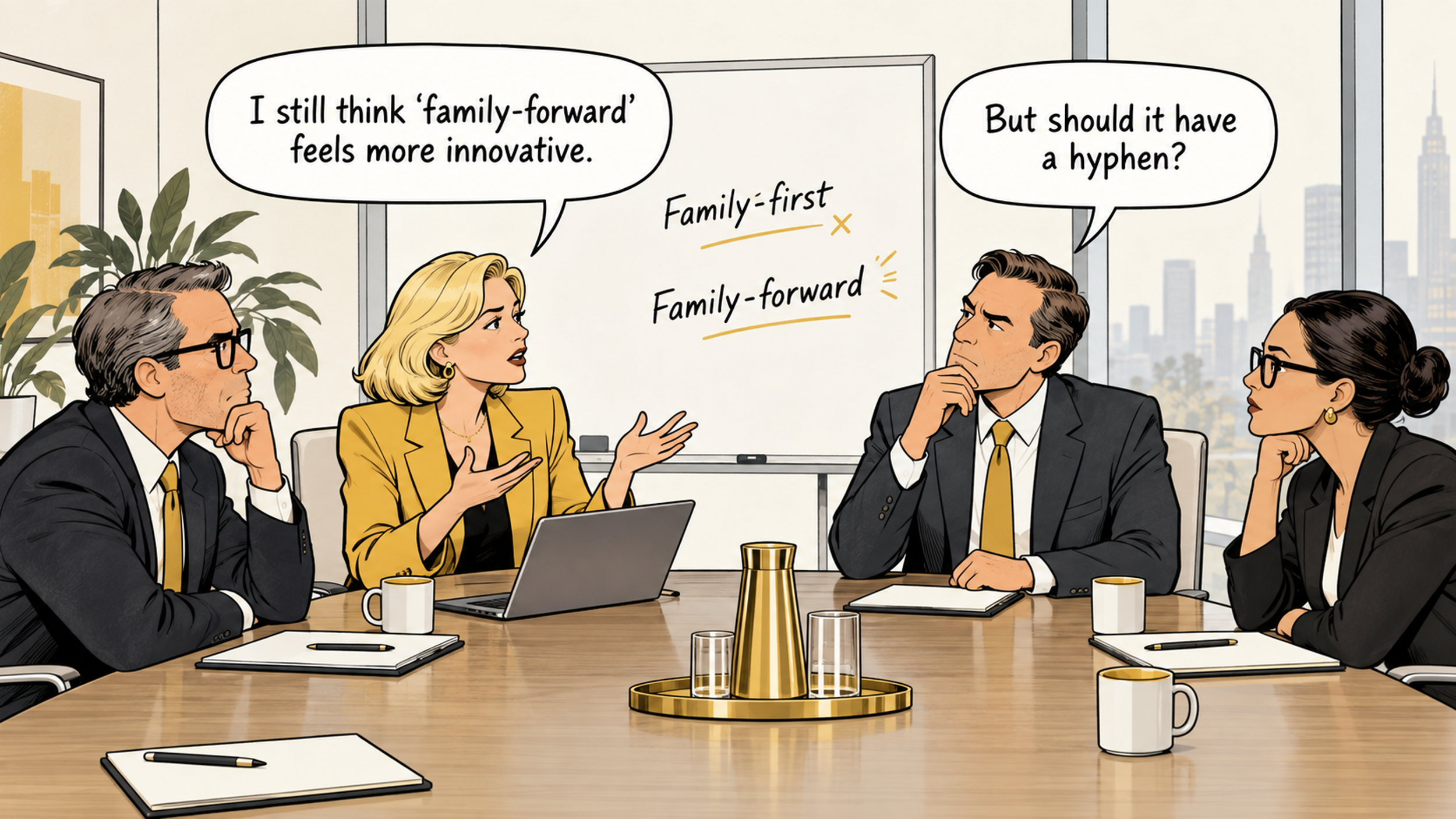
It’s entirely possible I’m bald now because of all the hair I pulled out during executive wordsmithing sessions.
I remember one time I sat in a meeting with 12 executives who spent three hours debating a single bullet point, and at the end of those three hours, the decision was to revisit it the following week. Seriously. Add up the salaries of everyone at that table across that meeting and the ones that followed, and I think I finally understand where the phrase “$64,000 question” came from.
C. Northcote Parkinson made fun of this kind of thing in his 1957 book Parkinson’s Law, where he described what he called the Law of Triviality. His fictional committee approved a nuclear reactor in a few minutes and then spent far longer debating a bike shed. Hardly anyone understood reactors, but everyone had an opinion about bike sheds. Anyone who has worked in marketing knows this feeling. Everyone has been marketed to their whole life, so everyone has an opinion about a tagline.
But sometimes what looks like a bike-shed debate is an important decision buried under the surface of a trivial one.
That was what happened in our meeting. It really was never about the words. It was about what wasn't being said out loud. The bullet was about our service standards, and specifically how much we wanted to script what associates said to customers when they first walked in the store, and how much to leave to their own personality. I can’t swear to the exact words, but I’m pretty sure a big chunk of those three hours went to whether we should “empower” associates or “enable” them.
Behind the words, the reality was the “empower” advocates wanted associates to bring their own personality to the greeting, and the “enable” supporters wanted to give them a specific greeting they could use to maintain consistency. Both are reasonable positions, but they are different directions that lead to different actions like different in hiring and training.
Every round of edits on that bullet was a proxy war for a direction, but arguing about the words let us avoid making the most meaningful decision.
Even the disagreement about scripting was mostly about tactics.
The strategic question that was really at play was what kind of customer experience we believed would lead to better business outcomes. Did we believe allowing associates to use their own personality would convert more visits into purchases and give customers a reason to come back? Or did we believe consistency would produce better results because customers wouldn’t get wildly different experiences depending on who greeted them?
Stronger connections and a more reliable experience are really just means to an end. Ultimately, we needed to agree on how we expected the customer experience to increase sales through things like conversion and retention.
We never really had that conversation.
Without that agreement, wordsmithing turns into a negotiation. Each executive pushes for the word that supports their version of the idea, and the ultimate “solution” is language vague enough that everyone can sign off on it. But each person walks out of the meeting with something a little different in mind. Meanwhile, the store manager training new associates still isn’t clear on what a successful greeting should accomplish.
Agreeing on the business outcome gives the team a way to move beyond defending their own version of the idea. If we want to increase sales by converting more store visits into purchases, which approach contributes most to the desired result?
Those are things we can test. We can explain why we believe an approach will work, then test those assumptions and validate whether it actually improves the outcome we care about before we finalize the approach and the language that describes it. We don’t have to settle all of that by arguing around a conference table.
So how do you find out whether the team agrees on the idea?
I use a simple exercise in my offsite workshops (shameless plug, and it’s also in the book). Before anyone discusses wording, each person writes down in their own words what they think the idea is and what it means for the business. What business outcome are we trying to improve? What customer experience do we believe will help us get there, and why? What would people actually do if they followed it?
Then everyone shares, and you capture where the versions differ. Those differences can then serve as the agenda for the meeting.
Work through them until you agree on both the outcome you want and the choices you’re making to achieve it. In our case, agreeing that customers should feel welcome wouldn’t have been enough. We needed to agree on how we expected that welcome to contribute to sales, whether through converting more visits into purchases, bringing more customers back, or both. Then we could assess whether associates should follow a script, create their own greeting, or work within some agreed boundaries.
Once those decisions are made, the team has something to measure the wording against. The question goes from “which word do I like better?” to “which wording makes our decision clear?” That’s a question the team can answer.
Testing the approach tells you whether it delivers the business outcome. Asking people how they’d put it into practice tells you whether they understand it. If their answers match what you agreed to, the words are good enough.
