
The Conventional Business Wisdom Trap
Strategy execution fails in predictable ways. Over the previous six weeks, I've explored six traps nested inside the larger Strategy Trap. These are patterns that consistently derail even well-designed strategies, and what to do about each one.
Part 7 of 6 (The epilogue)
There's an old saying that doing the same thing over and over and expecting a different result is the definition of insanity.
Research by Kaplan and Norton found that 90 percent of organizations fail to execute their strategies successfully. Harvard Business Review reports that 67 percent of well-formulated strategies fail due to poor execution. Most leaders have lived those numbers. And yet the approach to execution rarely changes.
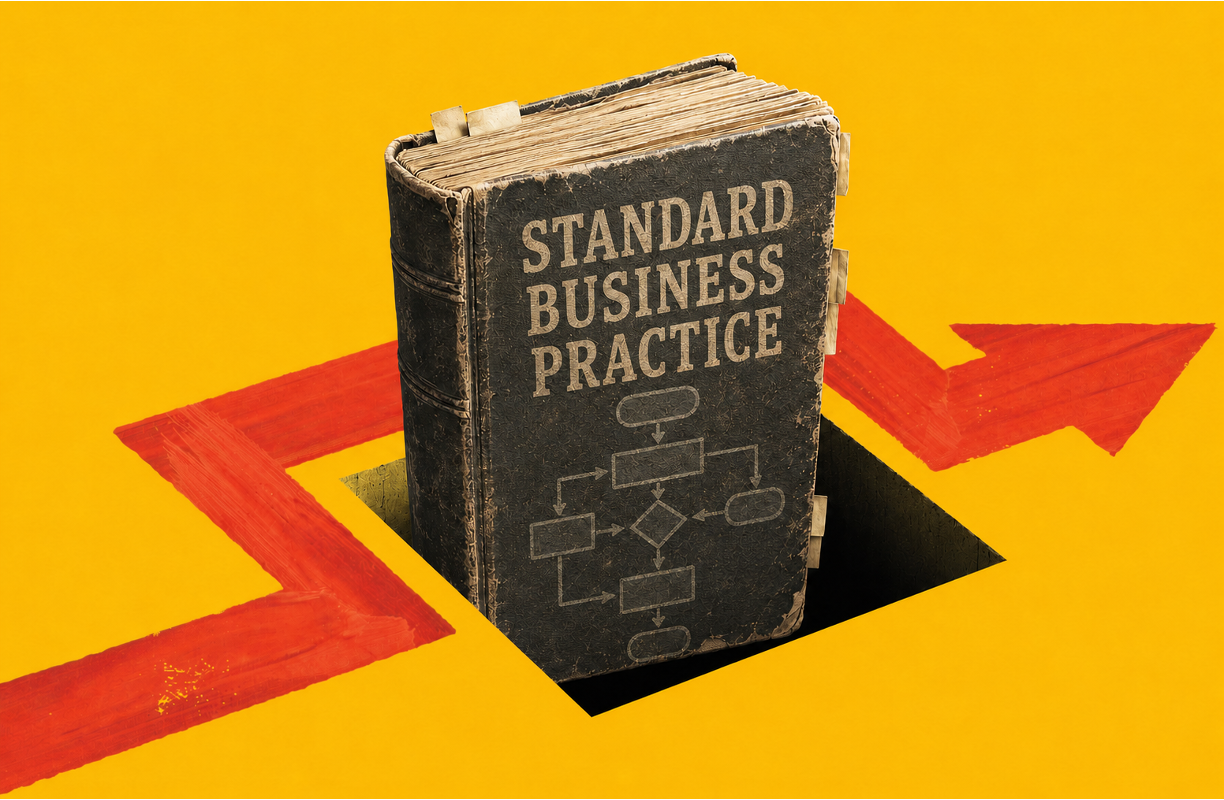
Over the previous six weeks, this series walked through six traps that consistently derail strategy execution: the Isolation Trap, the Complexity Trap, the Overcommitment Trap, the Signal Fade Trap, the Silo Trap, and the Ivory Tower Trap. Each one is distinct and recognizable. And each one is a direct consequence of the standard approaches most organizations follow without much examination. Call it the Conventional Business Wisdom Trap.
The conventional approach pattern you’re probably familiar with: build the strategy, hand it off, communicate it at launch, assign ownership by function, and trust capable people to run with it. Each of those steps seems reasonable in isolation. Taken together, they create exactly the conditions where the six traps take hold.
They're what leadership teams have always done, what they've seen others do, and what gets passed down as the way it’s done. But the numbers suggest that model isn't working.
What It Looks Like in Practice
Execution keeps breaking down in the same places despite different strategies. The strategy changes. Post-mortems get conducted, and lessons get documented. Yet the same patterns resurface because the approach to execution itself didn't change.
There's no shortage of action, but the results don't follow. Teams are busy, initiatives are moving, and milestones are being hit. But the outcomes the strategy was supposed to produce still aren't materializing. The conventional model measures what's easy to track--like launches, activities, and completed tasks--and assumes the actual results will follow. All too often they don't.
When execution falls short, the strategy gets revised. The assumption is that a better strategy will produce better results. But often the strategy was fine. The conditions for executing it weren't, and those conditions don't get examined because they aren't part of the conventional model.
A Few Questions Worth Considering
When execution has fallen short in the past, did the response focus on improving the strategy, or on examining the conditions that made execution difficult?
Which of the six traps in this series felt most familiar? Has that pattern repeated itself across multiple strategies?
How much of your current approach to execution is deliberate, and how much is simply how things have always been done?
If you ran a post-mortem on your last major strategy effort, would the lessons point to a better strategy or to a different way of executing?
What to Do About It
Each of the six traps has its own antidote, and this series has pointed to each one. But the traps share a common root: an unexamined assumption that the conventional approach to execution is the right one. Examining that assumption is where the more meaningful change happens.
The Six Cs system—Co-creation, Clarity, Capacity, Communication, Coordination, and Coaching—is built on the premise that strategy and execution aren't sequential phases. They're one continuous process, and the conditions that make execution possible have to be present from the beginning. Each C addresses one of the assumptions the conventional model gets wrong. Together, they give leaders a practical system for turning strategies into real results.
If you want to go deeper on how to put that into practice, it's all in The Strategy Trap.
