
Your Company Values Should Actually Do Something
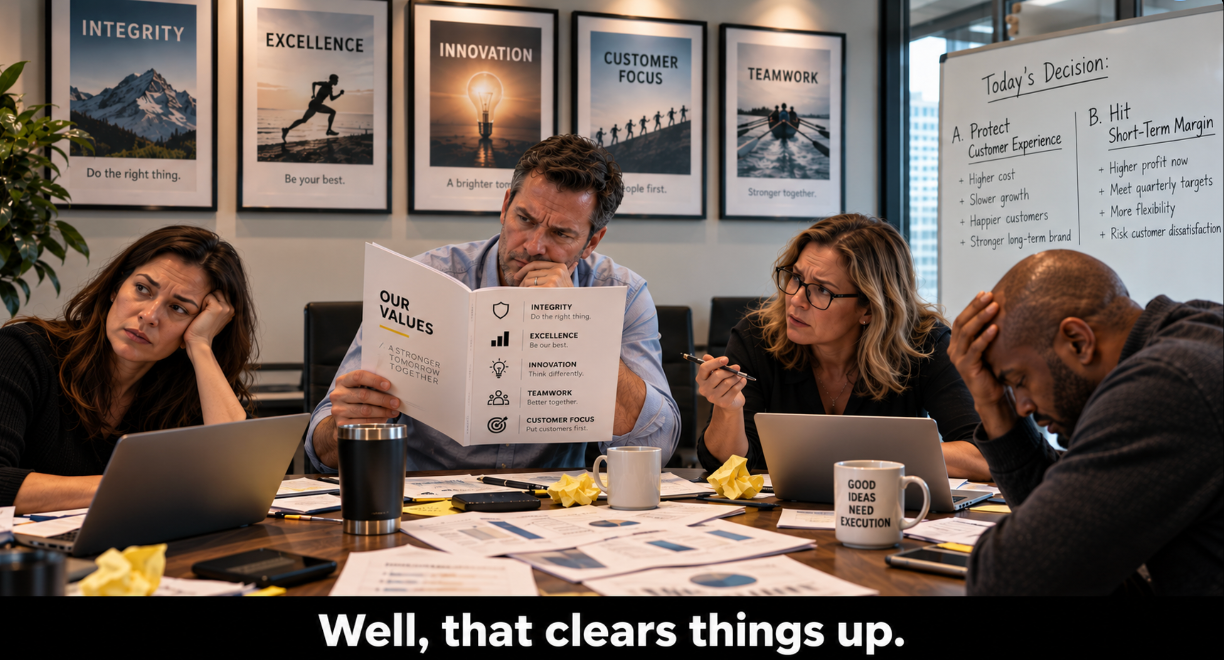
Company values may be one of the biggest wasted opportunities I’ve seen in business.
Almost every company has them. And all too often, they’re bland platitudes that don’t tell anybody much of anything.
You’ve probably seen them:
Integrity. Excellence. Innovation. Customer focus. Teamwork.
I’m certainly not against any of those things. But what am I supposed to do differently because “Integrity” is one of our values? In my experience, nobody ever really knows or even really considers it.
That’s a shame, because values can be an incredibly powerful tool for execution.
Execution is ultimately about getting a whole bunch of people moving in the same direction. You can’t possibly tell everyone what to do in every situation they’re going to encounter. People have to figure things out for themselves. So they need to understand how they’re expected to behave, and they need to be able to make decisions that move the company in the direction it’s trying to go.
I think there are two really powerful, and often underused, tools for doing exactly that.
Values should tell us how we behave. Guiding principles should tell us how we decide.
Values should define behavior
Danny Meyer, the founder of Union Square Hospitality Group, has my favorite definition of culture:
“The culture you have in your organization is the sum of all the wanted behaviors that you celebrate, minus all the unwanted behaviors that you tolerate.”
I love that because it makes culture incredibly concrete. Culture gets built every day through the behaviors you reinforce and the behaviors you’re willing to tolerate.
If culture is created through behavior, then your values should help people understand what those behaviors have to be.
Trip Randall, CEO of Superfeet, gave me a great example when I interviewed him for The Strategy Trap. Superfeet has what they call their “No Jerk Policy.” It’s a simple but powerful concept. You can be incredibly talented and deliver great results, but if you can’t treat other people with respect, you aren’t going to last there. Collaboration and respect come first, and they reinforce that expectation through hiring, feedback, and everyday decisions.
Isn’t that a lot more useful than just putting “Respect” on the wall with a nice stock photo? The “No Jerk Policy” tells people what the company expects and, maybe even more importantly, where the line is. And getting results doesn’t give you permission to cross it.
Don’t start with wordsmithing
This is where I think a lot of leadership teams get themselves into trouble. They start with the wordsmithing a concept. “How about Act with Integrity?” I mean, who wants to be the person arguing against integrity? Then they spend the next 20 minutes debating what those words actually mean for their company.
I think it’s better to start with what you actually believe about how people need to behave to work effectively together. Get specific about what you would expect people to do because of that belief, what you would see happening if people were actually living it, and what behavior would clearly cross the line. Only after you’ve done that work should you worry about coming up with a memorable catchphrase to summarize it.
Let’s say your team believes that collaboration in your organization works best when people treat each other with respect. How should that come to life? Anyone should be able to recognize what living that value looks like. Maybe it means we disagree directly instead of talking behind each other’s backs. We listen to different perspectives. We give honest feedback. And we don’t excuse disrespectful behavior just because someone happens to deliver great results.
Now “respect” means something much more actionable and unified.
A really helpful way to help people internalize the value is to add a question. For this one, it might be:
Am I treating this person with the same respect I would expect from them, especially when we disagree?
A statement tells me what the company believes, but a question forces me to think about whether my behavior right now matches it.
Behavior gets you halfway there
A McKinsey study found that managers across a company make thousands of operating decisions every day. Those decisions can't all go through some bureaucratic escalation process.
All those seemingly small decisions add up. Should we spend a little more to make this customer happy? Should we launch now or wait until the product is better? Should we customize something for one large customer? Should we take a piece of revenue that doesn’t really fit where we’re trying to go? Should we move faster and accept a little more risk?
You really don’t want everyone waiting for a senior leader to tell them what to do. And you certainly don’t want every person making those trade-offs differently.
That's where guiding principles are critical. They give people a way to make those everyday trade-offs on their own, while still making them in a way that's consistent with where the company is trying to go.
A good guiding principle helps people make a decision when two reasonable choices compete. That last part is what matters. If one choice is obviously good and the other is obviously stupid, you don’t need a guiding principle. You need common sense.
But a lot of decisions are harder than that. Do we prioritize speed over perfection? Are we going after growth at the expense of profitability?
Both choices can have a legitimate argument. A good guiding principle tells people which way the company wants them to lean.
A good guiding principle should make a choice
Just like with values, it’s better to start with the decision you’re trying to help people make before wordsmithing that pithy statement.
First, what kind of decision or tension are we trying to make easier? Then ask, when two good options compete, what do we prioritize? Do we still believe in that choice when following the principle costs us something? Finally, make the implications concrete. What does this mean we will or won’t do?
Imagine a company that has repeatedly struggled with the tension between protecting its customer experience and hitting short-term financial targets. (It might not take much imagination.)
After working through that tension, its leaders establish a guiding principle:
Customer Experience Before Short-Term Margin
That tells me something clear.
It acknowledges that both things matter. The company wants to make money. But when those two priorities come into conflict, people now know which trade-off to make.
Then do the same thing we did with the value and turn it into a question:
Are we improving short-term results at the expense of the experience we want customers to have?
Now when someone three levels down in the organization is facing a decision where those two things come into conflict, they have a pretty good idea how the company wants them to think about it.
They don’t need another meeting, a 23-page policy, or, most importantly, to ask their boss.
It’s essentially pre-approved.
Your final test to see if it’s right—and that you can live with the decisions people will make—is asking yourself, “Would this help someone choose between two reasonable options without having to ask me?”
Both become execution tools
Your strategy eventually has to turn into thousands of individual actions and decisions made by people throughout the organization. You can’t prescribe all of those in advance.
What you can do is make the boundaries clearer.
Values create behavioral guardrails. Guiding principles create decision guardrails.
Good guardrails give people more freedom. If I understand how I’m expected to behave and how the company wants me to think about important trade-offs, I can move without waiting for someone above me to tell me what to do.
That’s exactly what you want if you’re trying to execute a strategy effectively and efficiently across an organization.
Take another look at yours
Pull up your company’s values and read each one. Ask yourself, “Would someone know how to behave differently because of this?” Then see if you can write a simple question someone could ask themselves when they’re trying to live up to it. If you can’t do either, the value probably needs more work.
Then look at your strategy. What are the handful of trade-offs people are going to encounter over and over again as they try to execute it? Those are candidates for guiding principles. Ask yourself whether a principle could help people make those decisions consistently without having to keep pushing them up the organization.
If you want to work through this with your team, I created a free, simple Values & Guiding Principles worksheet that walks you through the process. It starts by helping you figure out which one you’re actually trying to create, then gives you a different set of questions for building each one. It also helps you turn each value or principle into a question people can use when they’re actually doing the work.
