
Strip It Down
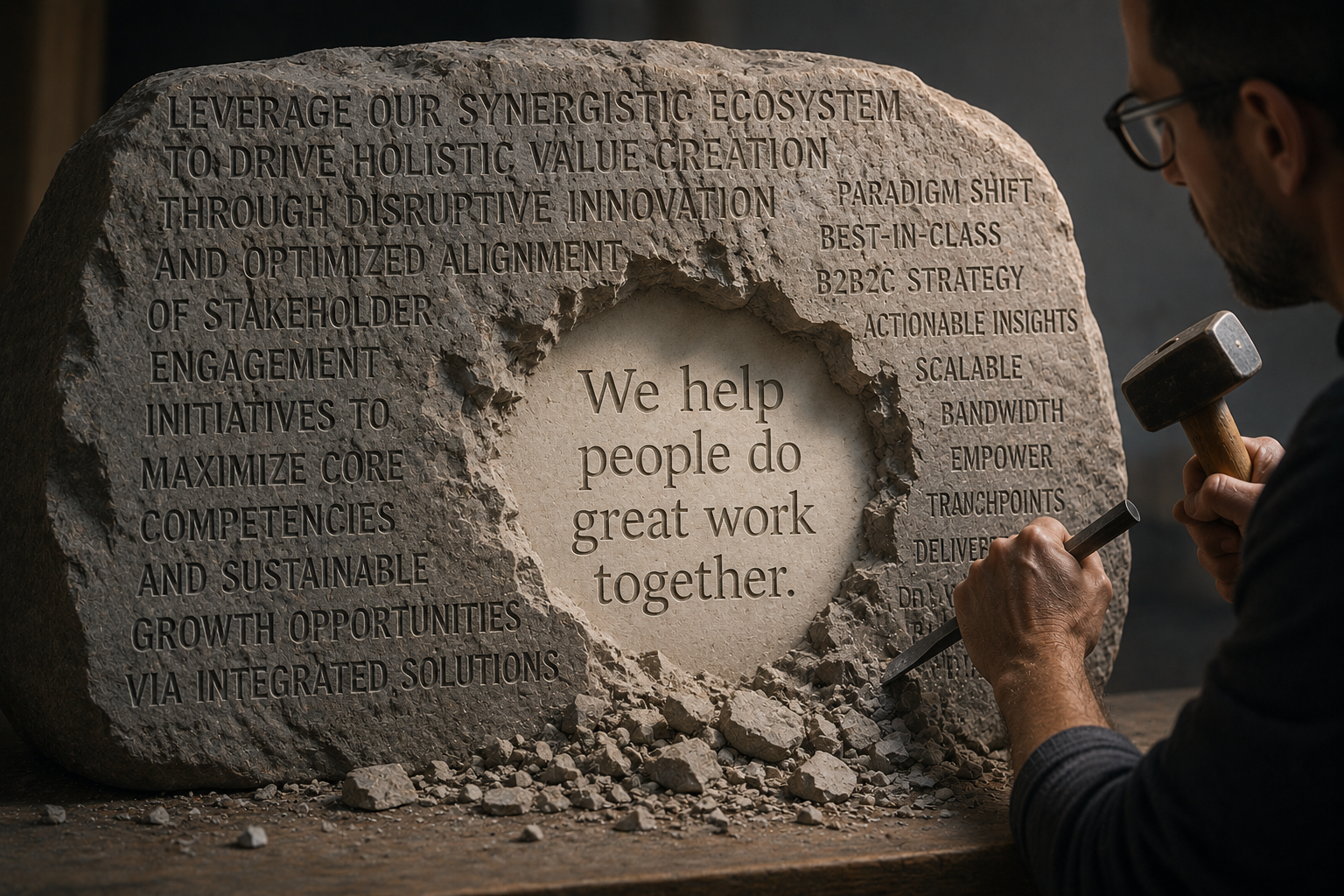
I came across this line from Rick Rubin's The Creative Act recently and couldn't stop thinking about it:
"Distilling a work to get it as close to its essence as possible is a useful and informative practice. Notice how many pieces you can remove before the work you're making ceases to be the work you're making."
He's talking about music. But swap "work" for "strategy" and it applies just as well.
All too often, strategies are filled with complicated business jargon that doesn't translate well to the general population of a business. I don't think people do that just to sound smart. I think they actually believe they're being more precise. Words like "leverage," "ecosystem," "holistic," and "stakeholder value" feel specific to the person who wrote them. The problem is the curse of knowledge—once you know what you mean, it's almost impossible to hear how it sounds to everyone else.
I have been plenty guilty of this in the past. I genuinely believed I was adding clarity, but I was really just confusing people.
WeWork's 2019 IPO prospectus is an extreme example. They described themselves as offering "flexible access to beautiful spaces, a culture of inclusivity and the energy of an inspired community, all connected by our extensive technology infrastructure."
They were renting office space.
I think AI is actually a good tool for helping with simplifying language and ensuring clarity. You can take your current strategy statement, drop it into an AI tool, and work through three prompts.
First: Rewrite this at eighth-grade readability. Keep the meaning. Cut the jargon. I ran WeWork's line through that and got this back:
"We give members access to flexible workspaces where they can connect with a welcoming community, supported by technology that makes it easy to work anywhere."
Better. But then the second prompt: Where is this still vague or unclear? It came back with this: "Flexible workspaces" doesn't say what kind of flexibility—hours, locations, desk types? "Welcoming community" doesn't explain who these people are or what connecting with them actually looks like. "Technology that makes it easy to work anywhere" doesn't say what the technology does or why it matters.
So I took another pass to address those gaps: "We rent office space by the day, month, or year—no long-term lease required. Our locations are designed so members naturally cross paths, share ideas, and build relationships. Everything you need to get to work is already set up when you walk in."
Clearer. But Rubin's point isn't just about clarity—it's about essence. So the third prompt: Strip this to its absolute essence. Remove everything that isn't necessary.
"We rent ready-to-use office space by the day, month, or year to people who want to work alongside a built-in community."
One sentence. Memorable, understandable, and meaningful. Everyone in the company knows exactly what they're there to do.
